

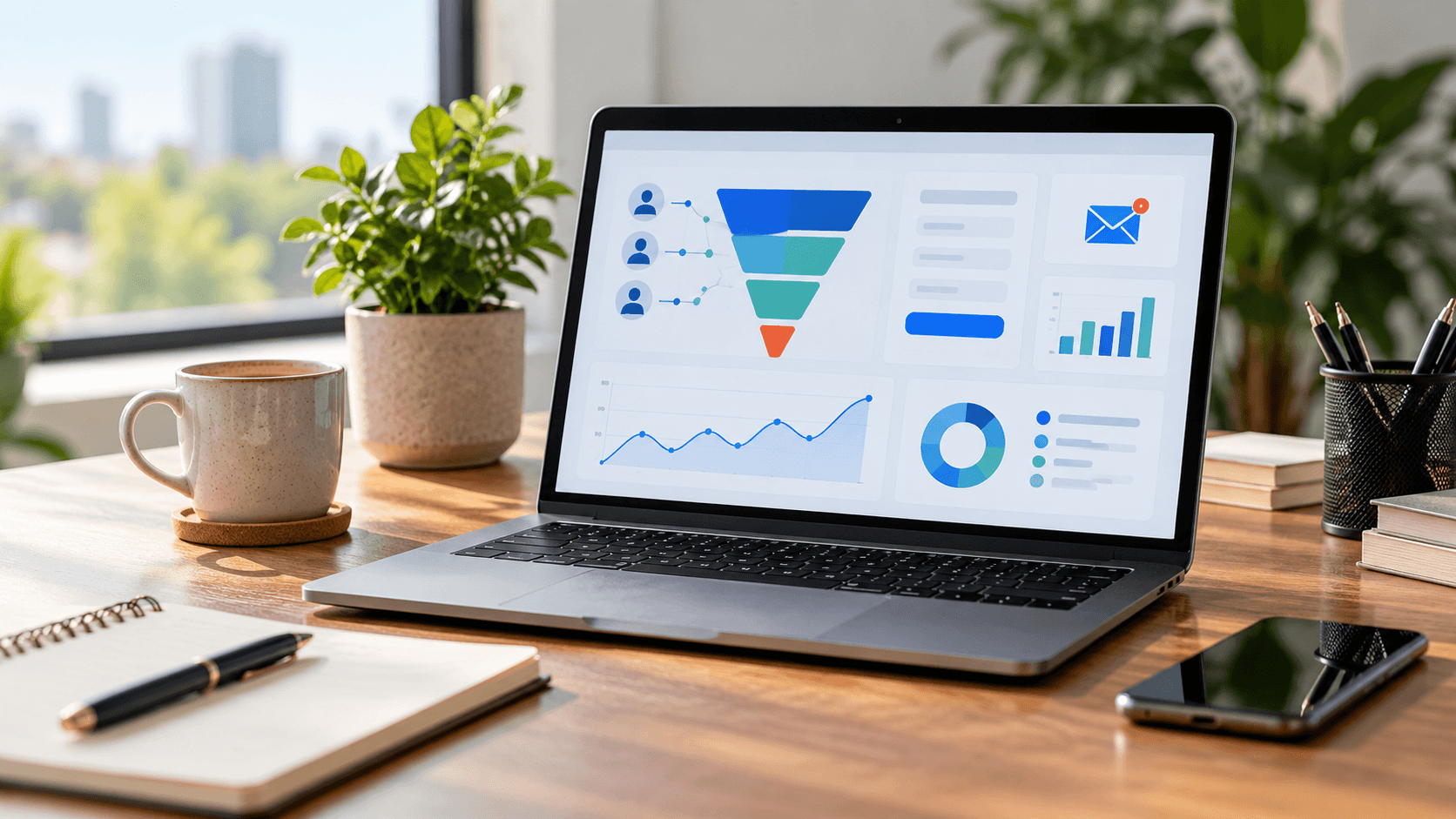
Getting more website traffic does not automatically mean getting more customers.
A business can attract 20,000 visitors in a month and generate almost no sales opportunities. Another company might receive only 2,000 visitors but consistently turn them into consultation requests, demos, quotations, and paying customers.
The difference is usually the lead generation system behind the traffic.
If you want to understand how to generate leads online, you need to think beyond individual tactics such as running ads or publishing blog posts. An effective system attracts the right people, gives them a reason to identify themselves, captures useful information, qualifies their potential value, follows up appropriately, and measures which marketing activities eventually produce customers.
SEO, PPC, landing pages, email, social media, webinars, retargeting, and lead magnets can all contribute. They work best when each has a clear role in the same customer journey.
Traffic, Leads, MQLs and Customers Are Not the Same Thing
Before building a lead generation strategy, define the stages you are trying to create.
Traffic
Traffic is simply people visiting your website, landing page, profile, or other digital property.
Someone reading a blog post is traffic.
They may be a perfect potential customer, an existing customer, a competitor, a student doing research, or someone who landed on the page accidentally.
Traffic creates opportunities. It is not a lead by itself.
Lead
A lead is normally someone who has identified themselves and shown some level of interest in your business.
That might happen when they:
- request a quotation
- download a guide
- join an email list
- register for a webinar
- submit a contact form
- request a demo
- start a free trial
The exact definition depends on your business.
Marketing Qualified Lead
An MQL, or marketing qualified lead, is a lead that meets criteria suggesting they deserve additional marketing or sales attention.
Qualification can use information about who the person is and what they have done.
For example, an MQL for a B2B software company might be someone who works at a company with more than 20 employees, has downloaded a relevant guide, visited the pricing page twice, and opened several emails.
HubSpot describes an MQL as a contact marketing considers more likely than other leads to become a customer based on factors such as content engagement, page visits, CTA activity, and other qualification criteria.
Customer
A customer has completed the action that produces revenue for the business.
That distinction matters because optimizing solely for “leads” can produce misleading results.
Campaign A might generate 500 leads at $10 each.
Campaign B generates 150 leads at $25 each.
Campaign A appears much better until sales data reveals that only five of its leads become customers while Campaign B produces 30 customers.
The goal is not always the cheapest lead. It is building a reliable path from traffic to qualified opportunities and customers.
1. Define What a Valuable Lead Looks Like
Before trying to increase lead volume, decide which leads your business actually wants.
A marketing agency might prefer:
- companies with at least 10 employees
- monthly marketing budgets above $5,000
- decision-makers rather than interns
- businesses needing SEO or paid advertising
- companies planning to hire within the next three months
A local home renovation business might care about:
- property ownership
- service location
- type of project
- budget
- expected start date
Those criteria should influence everything from advertising targeting to form questions.
Without them, the marketing team may celebrate rising lead numbers while the sales team complains that none of the prospects are worth contacting.
2. Use SEO to Capture Existing Demand
SEO is one of the strongest lead generation channels when potential customers already search for the problems your business solves.
Suppose you operate an accounting firm serving small businesses.
Potential searches might include:
- accountant for ecommerce businesses
- small business tax accountant
- bookkeeping services for Shopify stores
- outsourced accounting for startups
Those searches have obvious commercial potential.
You can also reach earlier-stage prospects through informational content:
- how to manage ecommerce bookkeeping
- common small business tax mistakes
- when should a business hire an accountant
The purpose of these articles is not simply generating pageviews.
They can introduce potential clients to your expertise, answer their initial questions, and direct appropriate readers toward service pages, consultations, newsletters, or downloadable resources.
Google’s current guidance emphasizes creating helpful content for an intended audience rather than publishing pages primarily to manipulate search rankings.
For lead generation, that means targeting topics that overlap with real customer problems and your services, not every keyword capable of producing traffic.
3. Use PPC for High-Intent Searches
SEO takes time. PPC can put your business in front of potential customers much sooner.
Google Ads is particularly useful when people actively search for services or solutions such as:
- personal injury lawyer consultation
- commercial cleaning company
- business insurance quote
- CRM software demo
- website development agency
These searches indicate stronger intent than someone casually scrolling through social media.
Build campaigns around tightly related intent groups and send visitors to pages matching what they searched for.
An advertisement about corporate website development should not send someone to a generic homepage covering branding, mobile apps, SEO, graphic design, and ten other services.
Match:
Keyword → advertisement → landing page → offer
The closer that sequence is, the easier it becomes for the visitor to understand what to do next.
Google Ads also supports lead form assets that allow eligible advertisers to collect information directly from Search and Performance Max ads instead of requiring every prospect to visit a website first.
4. Build Landing Pages Around One Conversion Goal
A homepage has to explain your entire business.
A landing page can focus on one audience, problem, service, or campaign.
That makes it particularly useful for lead generation.
A strong landing page usually answers:
What are you offering?
Who is it for?
What problem does it solve?
Why should someone trust you?
What should they do next?
For example, a landing page for a cybersecurity consultation might include:
- specific headline
- short explanation of the service
- common security problems addressed
- relevant experience or proof
- client results or testimonials
- what happens during the consultation
- qualification form
- clear CTA
Remove unnecessary distractions.
If the objective is booking a consultation, you probably do not need 15 competing CTAs asking people to visit your blog, follow Instagram, download another resource, watch a video, and browse unrelated services.
5. Create Lead Magnets People Actually Want
Not every visitor is ready to request a sales call.
A lead magnet gives earlier-stage prospects a reason to provide contact information.
Common examples include:
- templates
- calculators
- checklists
- ebooks
- spreadsheets
- reports
- industry benchmarks
- email courses
- webinars
- free assessments
The best lead magnet solves a specific problem connected to the service you eventually want to sell.
A digital marketing agency could offer:
Google Ads Account Audit Checklist
That makes more strategic sense than:
50 Motivational Quotes for Entrepreneurs
The second resource might attract more downloads, but those people may have almost no connection to the agency’s services.
Lead quality begins with the offer.
6. Keep Lead Capture Forms Proportional to the Offer
Every additional form field creates another decision for the visitor.
For a simple newsletter, you might need only an email address.
For a high-value sales consultation, additional questions can save your team substantial time.
You might ask for:
- name
- phone
- company
- website
- company size
- project type
- budget range
- timeline
Do not collect information simply because your form software allows it.
Ask whether the information will actually be used.
There is also a tradeoff between lead volume and qualification. Short forms usually create less friction, while longer forms can help filter people who are unlikely to become customers.
Google’s current lead form guidance reflects the same principle. It allows advertisers to use additional questions and qualifying responses when lead quality matters more than collecting the highest possible number of submissions.
7. Use Email to Nurture Leads That Are Not Ready Yet
Someone downloading a guide today may not need your service until three months from now.
If you do nothing after the download, the lead may forget your business exists.
Email nurturing gives you a way to maintain the relationship.
A simple sequence might look like:
Email 1: Deliver the requested resource.
Email 2: Explain a common problem connected to it.
Email 3: Share a practical case study.
Email 4: Address an objection.
Email 5: Invite the reader to a consultation or demo.
Do not make every email a sales pitch.
Useful nurturing helps potential customers become better informed while gradually demonstrating why your business may be a suitable solution.
Segment emails where practical.
A person who downloaded an SEO audit checklist should receive different follow-up content from someone who registered for a Meta Ads webinar.
8. Generate Leads Through Social Media
Social media lead generation works best when the platform matches both the audience and buying process.
A B2B consultant might use LinkedIn.
A wedding photographer may find Instagram more useful.
A home improvement company could reach homeowners through Facebook and Instagram.
A software company might use YouTube to demonstrate complex workflows.
Social content can generate leads through:
- educational posts
- videos
- case studies
- direct-response advertisements
- webinars
- downloadable resources
- profile links
- direct messages where appropriate
Avoid judging social media only by follower count.
A LinkedIn account with 3,000 relevant business owners can be more valuable than an entertainment-focused account with 100,000 followers who will never purchase.
9. Retarget Visitors Who Did Not Convert
Most website visitors will not become leads during their first session.
Retargeting allows you to advertise again to people who have already interacted with your business, subject to platform rules, consent requirements, and applicable privacy law.
Different audiences can receive different messages.
Someone who visited a general blog post might see an educational lead magnet.
Someone who viewed the pricing page could see a customer case study.
Someone who started but abandoned a lead form might receive a stronger reminder.
Retargeting works because the audience already has some familiarity with the business.
Do not keep showing the same advertisement indefinitely. Build different creative and offers around the stage of the journey.
10. Use Webinars for Complex or High-Consideration Offers
Webinars work particularly well when customers need education before making a decision.
They are commonly useful for:
- B2B software
- consulting
- financial services
- professional services
- training
- complex technology
- expensive products
Choose a topic connected to a real customer problem.
A cybersecurity company might run:
How Small Businesses Can Prepare for a Ransomware Attack
Registration generates leads, while the webinar demonstrates expertise and allows the company to introduce its services naturally.
After the event, follow up differently with:
- attendees
- registrants who did not attend
- people who asked questions
- prospects who visited commercial pages afterward
A webinar registration itself may be a lead. Attendance plus high-intent behavior may be enough to qualify the person further.
11. Connect Lead Sources to Your CRM
A spreadsheet can work when you receive five leads per month.
It becomes risky when you generate hundreds.
A CRM, or customer relationship management system, can store:
- contact information
- original lead source
- campaign
- lifecycle stage
- sales owner
- communication history
- qualification data
- opportunities
- eventual revenue
This gives you something advertising dashboards alone cannot: visibility into what happened after the form submission.
Google Ads currently supports several lead-delivery methods, including webhooks and integrations that can send lead-form information into CRM systems. Its current best-practice guidance recommends faster CRM routing when quick follow-up is important.
Avoid manually exporting and importing leads indefinitely if an automated connection is reasonably available.
12. Track the Original Lead Source
Your CRM should ideally preserve information such as:
- source
- medium
- campaign
- landing page
- first conversion
- lead magnet
- sales outcome
Without this data, marketing eventually loses sight of which channels generate valuable prospects.
Imagine:
Google Ads generates 200 leads.
SEO generates 80.
Meta Ads generates 300.
Looking only at volume makes Meta appear strongest.
Now add sales results:
Google Ads: 30 customers
SEO: 20 customers
Meta Ads: 8 customers
The decision changes immediately.
Measure marketing as far down the funnel as reasonably possible.
13. Create an MQL Definition With Sales
Marketing and sales should agree on what qualifies a lead for direct follow-up.
A simple system might consider two categories.
Fit
Does the person resemble your ideal customer?
Examples:
- industry
- company size
- location
- job title
- budget
Intent
Has the person shown signs of serious interest?
Examples:
- pricing page visit
- webinar attendance
- demo request
- repeated email engagement
- service-page visits
Someone with excellent fit but little intent may need nurturing.
Someone with strong intent but terrible fit may never become a useful opportunity.
The best MQL definitions combine both.
HubSpot similarly recommends defining MQLs using behavioral engagement and demographic or firmographic fit, with marketing and sales agreeing on the criteria used for handoff.
14. Use Lead Scoring Where Volume Justifies It
Lead scoring assigns values to signals associated with potential customer quality.
For example:
Downloaded guide: +5
Attended webinar: +10
Visited pricing page: +15
Requested demo: +30
Target industry: +10
Company too small: -15
A lead reaching a certain threshold may become an MQL.
Do not create a complicated scoring system simply because large companies use one.
A local business receiving 20 enquiries per month can probably qualify them manually.
Lead scoring becomes more useful when marketing generates enough contacts that sales cannot evaluate every person equally.
15. Measure the Entire Lead Generation Funnel
Track more than form submissions.
Useful metrics include:
Traffic
- visitors
- channel
- landing page
Lead generation
- leads
- visitor-to-lead conversion rate
- cost per lead
Qualification
- MQLs
- lead-to-MQL rate
- cost per MQL
Sales
- sales-qualified leads
- opportunities
- customers
- close rate
Economics
- customer acquisition cost
- revenue
- customer lifetime value
- return on marketing spend
Google Analytics currently allows businesses to mark important user actions as key events and evaluate the channels contributing to them. Google now uses “conversion” specifically for important actions used to measure and optimize advertising performance.
For lead generation, a form submission is useful to track, but your reporting should eventually connect that submission to the quality and value of the resulting customer.
Build a Lead Generation System, Not a Collection of Campaigns
The strongest online lead generation usually follows a connected process:
Attract the right audience.
Use SEO, paid advertising, social media, webinars, and other channels where your potential customers actually spend time or search for solutions.
Capture interest.
Use landing pages, forms, consultations, lead magnets, trials, or registrations.
Store the lead.
Send contact and source data into a CRM rather than leaving it scattered across advertising platforms and spreadsheets.
Qualify the opportunity.
Separate casual enquiries from prospects with the fit and intent required to become valuable customers.
Nurture when necessary.
Use email, content, retargeting, and sales follow-up based on the prospect’s stage.
Measure revenue.
Work backward from customers and qualified opportunities to understand which channels, campaigns, landing pages, and offers actually contribute to growth.
That is the difference between generating random form submissions and building a predictable online acquisition system.
More traffic can help, but only when the right people arrive. More leads can help, but only when enough of them are qualified. The objective is to connect marketing activity with genuine sales opportunities and eventually customers.
Once you can trace that path reliably, deciding where to spend the next dollar or publish the next piece of content becomes much easier.